
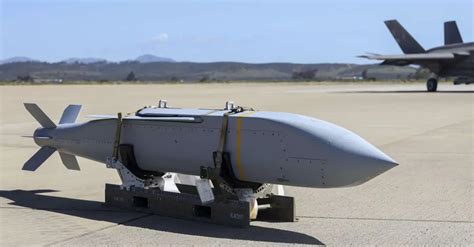
I’ll help you create a blog post about the AGM-154 Joint Standoff Weapon. I’ll first do a web search to gather accurate information. Based on the search results, I’ll create the blog post about the AGM-154 Joint Standoff Weapon:
The AGM-154 Joint Standoff Weapon (JSOW) represents a cutting-edge precision-guided glide bomb that revolutionized air combat capabilities for the United States military. Developed by Raytheon (formerly Texas Instruments) in the early 1990s, this advanced weapon system provides military aircraft with a powerful, long-range strike capability that minimizes risk to pilots and maximizes mission effectiveness.
Origins and Development

The JSOW program began in 1986 as a joint initiative between the U.S. Navy and Air Force to create a versatile standoff weapon. The primary objective was to develop a fire-and-forget weapon that could engage targets beyond enemy air defense ranges. In 1992, Texas Instruments won the development contract, marking a significant milestone in precision munitions technology.
Technical Specifications

The AGM-154 JSOW boasts impressive technical capabilities:
- Length: 4.1 meters (160 inches)
- Weight: Approximately 483 kg (1,065 lbs)
- Range:
- Low-altitude launch: 22 km (12 nautical miles)
- High-altitude launch: 130 km (70 nautical miles)
- Guidance System: GPS/Inertial Navigation System (GPS/INS)
Variants and Capabilities

The JSOW family includes multiple variants designed for different mission profiles:
AGM-154A

The baseline version carries 145 BLU-97/B Combined Effects Bomblets, making it ideal for: - Attacking soft targets - Engaging vehicle concentrations - Neutralizing surface-to-air missile sites
AGM-154C

This advanced variant features a BROACH multi-stage penetrating warhead, specifically designed for: - Hardened targets - Fortified installations - Bunker penetration
AGM-154A-1
A Foreign Military Sales (FMS) version equipped with a 500-pound BLU-111 unitary warhead, providing focused explosive impact against fixed targets.
Operational Deployment
The JSOW entered operational service in 1999 and has been deployed across multiple platforms:
- Navy Platforms:
- F/A-18 Hornet
- F/A-18 Super Hornet
- AV-8B Harrier
- Air Force Platforms:
- F-16 Fighting Falcon
- B-1 Bomber
- B-52 Stratofortress
- F-15 Strike Eagle
International Adoption
The AGM-154 has been adopted by multiple allied nations, including: - Australia - Canada - Finland - Greece - Poland - Singapore - Turkey
🚀 Note: The JSOW's ability to strike targets from beyond enemy air defenses significantly enhances mission survivability and operational flexibility.
The weapon system represents a quantum leap in precision strike capabilities, allowing military aircraft to engage critical targets with unprecedented accuracy and reduced risk to personnel.
What makes the JSOW unique?
+
The JSOW’s fire-and-forget capability, long-range precision, and modular warhead design set it apart from traditional munitions. It can be deployed from multiple aircraft platforms and adapted for various mission requirements.
How accurate is the JSOW?
+
The JSOW boasts a Circular Error Probable (CEP) of less than 3 meters, making it extremely precise for both area and point targets.
Can the JSOW engage moving targets?

+
The standard AGM-154A cannot engage moving targets. However, the AGM-154C variant includes an imaging infrared seeker that provides enhanced terminal guidance capabilities.
